Essential Options Trading Terms Every Trader Must Know Before Using AOC
Basic Of AOCRaj Shah

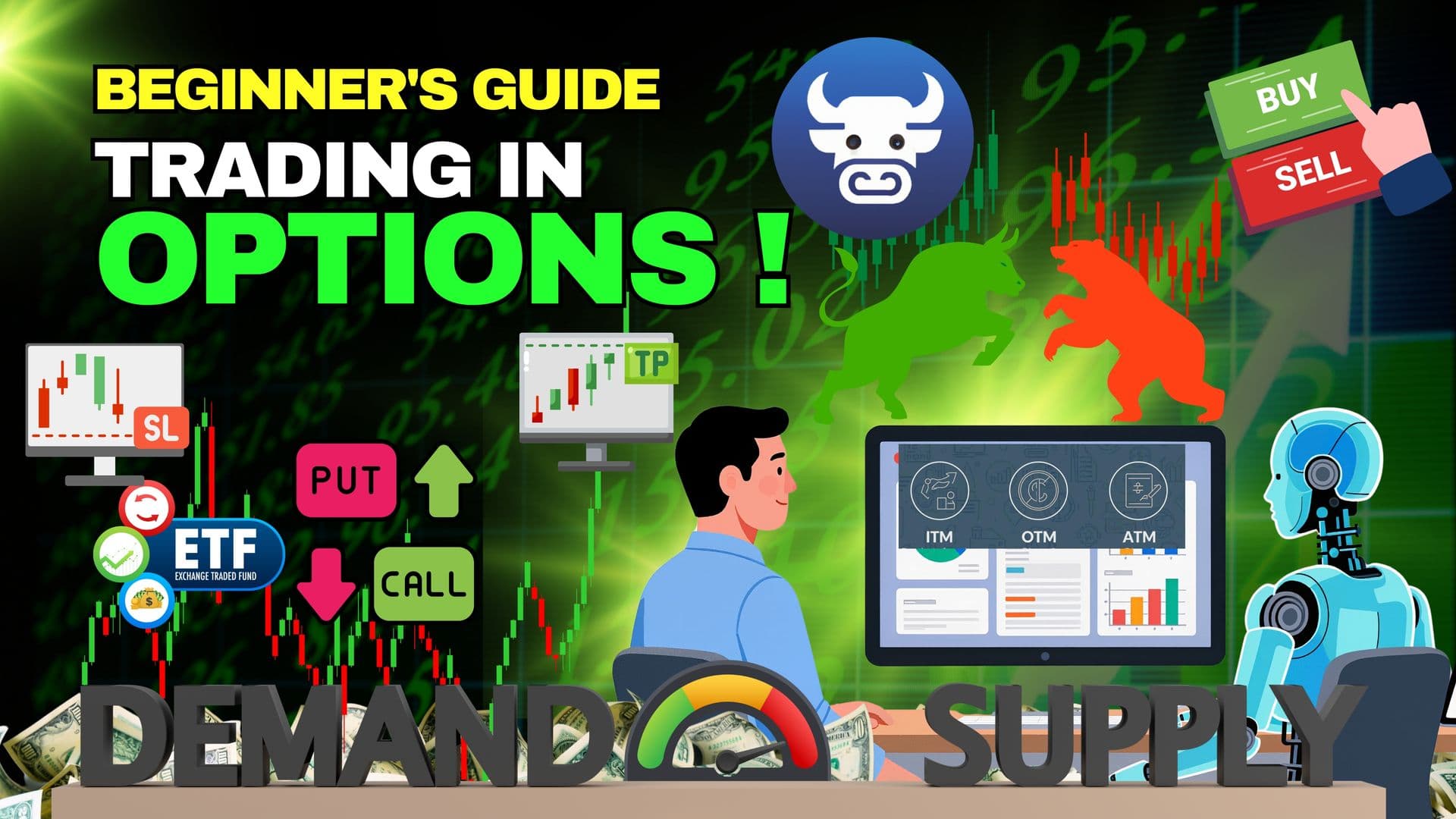
Master Essential Options Trading Terms for Smarter Trading with Advance Option Chain (AOC)
Understanding key options trading concepts is crucial for making informed, confident, and profitable decisions in the dynamic world of financial derivatives. Whether you're a beginner or an experienced market participant, mastering these fundamental options trading terms will significantly help you navigate an Advance Option Chain (AOC) more effectively and build strong, data-driven strategies.
Options are financial derivatives that derive their value from an underlying asset, such as stocks, commodities, or indices. This enhanced guide is designed to cover all essential terminology—from Strike Price and Option Types to Open Interest (OI), Volume, Implied Volatility (IV), and the Option Greeks—so you can trade smarter with AOC.
I. Fundamental Building Blocks: Strike Price and Option Types
To begin your journey into options trading, you must first grasp its foundational elements: the Strike Price and the various types of options.
A. Strike Price: The Exercise Level
The Strike Price, also known as the exercise price, is the predetermined fixed price at which the underlying asset can be bought (for a call option) or sold (for a put option) if the option is exercised. It is a pivotal factor in option pricing and directly impacts an option's potential profitability. The relationship between the Strike Price and the current market price of the underlying asset determines an option's "moneyness":
In the Money (ITM)
At the Money (ATM)
Out of the Money (OTM)
B. Types of Options: Call vs. Put
Options are broadly classified into two major categories:
🟢 Call Options: These derivatives give the buyer the right (but not the obligation) to buy the underlying asset at the specified strike price on or before the expiration date. Call Options are typically bought by traders who are bullish, expecting the price of the underlying asset to increase.
🔴 Put Options: Conversely, Put Options grant the buyer the right (but not the obligation) to sell the underlying asset at the strike price on or before the expiration date. Put Options are favored by traders who are bearish, anticipating a decline in the underlying asset's price, or to hedge against a potential fall in value of assets they already own.
C. Understanding the Option Chain Layout (AOC Style)
An Option Chain, also known as an options matrix, is a tabular representation of all available options contracts for a given underlying asset. An Advance Option Chain (AOC) provides a more detailed and analytical view, often including additional metrics like Implied Volatility, Open Interest, Volume, and the Greeks.
Understanding this layout is essential for quick analysis:
Call Options are typically displayed on the left side of the chain.
Put Options are usually found on the right side.
Strike Prices are listed in the middle column, organizing the contracts.
II. The Players: Option Buyer vs. Option Writer
In every options trade, there are two distinct roles: the buyer and the writer (seller). Their motivations, risks, and rewards differ significantly.
A. Option Buyer (Holder)
The Option Buyer, also known as the holder, pays a premium to acquire the options contract.
They have no obligation to exercise the option.
Their maximum risk is limited to the premium paid.
Their reward potential is theoretically unlimited.
Buyers acquire Call Options when they are bullish on the underlying asset.
Buyers acquire Put Options when they are bearish.
B. Option Writer (Seller)
The Option Writer, or seller, receives the premium from the buyer. In exchange, they undertake the obligation to fulfill the contract if the option is exercised.
Their profit is limited to the premium received.
Their potential loss is theoretically unlimited, especially for naked options.
Sellers typically write Call Options when they are neutral to bearish (expecting the price to stay below the strike or fall).
Sellers write Put Options when they are neutral to bullish (expecting the price to stay above the strike or rise).
Option Writers often profit from time decay (Theta), a concept we'll explore later, as the option premium erodes over time.
III. Strategic Applications: When to Execute Trades
The decision of when to buy or sell options largely depends on your market outlook regarding the underlying asset's direction, expected volatility, and time horizon. Options can be utilized for speculation, hedging, or income generation.
A. Expecting Market to Rise (Bullish Outlook)
If you anticipate the underlying asset's price to increase:
✔️ Buy Call Options: This strategy offers high profit potential with limited risk (the premium paid).
✔️ Sell Put Options: You earn a premium, expecting the price to stay above the strike price. This can also be used to acquire the underlying stock at a lower price if assigned.
B. Expecting Market to Fall (Bearish Outlook)
If you anticipate a decline in the underlying asset's price:
✔️ Buy Put Options: This is a direct way to profit from a downward move.
✔️ Sell Call Options: You earn a premium, expecting the price to stay below the strike price.
IV. Deeper Dive into Moneyness: ITM, ATM, OTM Explained
Moneyness of options describes the relationship between an option's strike price and the current market price of the underlying asset. This relationship determines an option's intrinsic value and risk profile.
A. At The Money (ATM)
At the Money (ATM) options occur when the strike price is approximately equal to or very close to the current market price of the underlying asset.
Example: If NIFTY is trading at 19,500, a call or put option with a 19,500 strike price is considered ATM.
ATM options typically have the highest extrinsic value and are most sensitive to changes in volatility and the underlying price.
B. In The Money (ITM)
In the Money (ITM) options possess intrinsic value, meaning they have immediate profit if exercised.
Calls: A Call Option is ITM if its strike price is below the current market price of the underlying asset. (e.g., NIFTY at 19,600, 19,500 Call is ITM).
Puts: A Put Option is ITM if its strike price is above the current market price of the underlying asset. (e.g., NIFTY at 19,400, 19,500 Put is ITM).
ITM options have a higher option premium due to this intrinsic value.
C. Out of The Money (OTM)
Out of The Money (OTM) options have no intrinsic value and derive their entire value from extrinsic factors.
Calls: A Call Option is OTM if its strike price is above the current market price of the underlying asset. (e.g., NIFTY at 19,500, 19,600 Call is OTM).
Puts: A Put Option is OTM if its strike price is below the current market price of the underlying asset. (e.g., NIFTY at 19,500, 19,400 Put is OTM).
OTM options are generally cheaper but riskier, as they rely solely on the underlying asset moving favorably before expiration to gain intrinsic value.
V. Crucial Market Indicators: Volume & Open Interest (OI)
Volume and Open Interest (OI) are vital market indicators for assessing liquidity, activity levels, and sentiment in options trading. AOC highlights these shifts in real time.
A. Volume: Activity Level
Volume represents the total number of options contracts traded during a specific period, typically a single trading day.
High Volume indicates high liquidity, making it easier to enter or exit positions with minimal price impact.
It provides a snapshot of current trading activity and can signal the strength of recent price moves.
B. Open Interest (OI): Market Commitment
Open Interest (OI) is the total number of active options contracts that have been opened but not yet closed or settled. Unlike volume, which resets daily, OI accumulates over time.
High OI signifies strong participation and a significant amount of capital committed to those contracts.
It can help identify potential support or resistance zones at specific strike prices.
Increasing OI, especially when combined with rising prices, often suggests a strong market trend or bullish sentiment, while decreasing OI might indicate a weakening trend or position closures.
C. OI Change Analysis (AOC Insights)
OI Change shows how many contracts are added or removed today, providing real-time insights into market sentiment and position adjustments.
Price Up + OI Up: Suggests a strong uptrend and fresh long positions being added.
Price Down + OI Up: Indicates weakness or short buildup, with new short positions being opened.
Price Up + OI Down: Often signals short covering, where existing short positions are being closed, potentially leading to a temporary price bounce.
Price Down + OI Down: Points to long unwinding, where existing long positions are being liquidated, confirming a bearish move.
VI. Understanding Market Expectations: Implied Volatility (IV)
Implied Volatility (IV) is a critical component in options pricing and represents the market’s expectation of future price fluctuations for an underlying asset.
A. Definition: Market's Forecast for Future Price Movement
IV is not a historical measure but a forward-looking forecast derived from the option's current market price. It reflects the market's collective opinion on how much the underlying asset's price will move.
B. Impact on Option Prices: High IV (Expensive) vs. Low IV (Cheaper)
High IV: Indicates that the market expects a large move, either up or down, leading to expensive options premiums. This often occurs during periods of uncertainty or before major events (e.g., earnings, policy announcements).
Low IV: Suggests the market anticipates less price movement, resulting in cheaper options premiums.
C. IV Crush: The Post-Event Price Drop
IV Crush (or volatility crush) is a rapid and significant decrease in an option's Implied Volatility, causing its price to fall sharply.
This phenomenon typically occurs after a major event (like an earnings announcement or FDA approval) that initially caused IV to spike due to heightened uncertainty.
Once the event passes and uncertainty dissipates, the demand for options often reduces, causing IV to drop abruptly.
IV Crush primarily affects the extrinsic value of options, making them cheaper, even if the underlying asset moves in your favor, but not as dramatically as the pre-event high IV might have suggested.
VII. Dissecting the Option Premium
An option's price, known as its Option Premium, is comprised of two main components: Intrinsic Value and Extrinsic Value.
A. Intrinsic Value: The 'Real' Value of ITM Options
Intrinsic Value is the portion of an option's premium that represents its "in-the-money" amount, or the immediate profit if the option were exercised at the current market price.
Only ITM options possess intrinsic value. ATM and OTM options have no intrinsic value.
At expiration, an option's value is 100% intrinsic value; if it expires OTM, it becomes worthless.
B. Extrinsic Value: Time, Volatility, and Other Factors
Extrinsic Value is the portion of an option's premium that exceeds its intrinsic value. It reflects the option's potential to become profitable before expiration and is influenced by external factors:
Time Value: The longer the time until expiration, the greater the time value, as there is more opportunity for the underlying price to move favorably. As expiry approaches, extrinsic value decreases due to Theta decay.
Volatility Value: Higher Implied Volatility increases extrinsic value, reflecting a greater expectation of large price swings.
Interest Rates and Dividends: These also play a role, though typically a smaller one compared to time and volatility.
VIII. The Essential Option Greeks for AOC Traders
The Option Greeks are mathematical measures that help traders understand how various factors affect an option's price. Understanding these is crucial for real-time option analytics and smarter decision-making with AOC.
✔️ Delta (Δ): Measures how much an option's price is expected to move for a $1 change in the underlying asset's price. It also approximates the probability that an option will expire ITM. Call options have positive Delta (0 to +1), while put options have negative Delta (0 to -1).
✔️ Gamma (Γ): Measures the rate of change in an option's Delta for a $1 change in the underlying asset's price. It indicates how much Delta will accelerate or decelerate. Gamma is typically highest for ATM options.
✔️ Theta (Θ): Represents the time decay component. Theta measures how much an option's price will decrease with the passage of one day, all else being equal. Options lose value each day as they approach expiration, a process that accelerates in the last 30-45 days. This eats into the option premium for buyers.
✔️ Vega (ν): Measures the sensitivity of an option's price to a 1% change in the underlying asset's Implied Volatility. Higher Vega means the option's price is more sensitive to IV changes.
✔️ Rho (ρ): Measures the sensitivity of an option's price to a 1% change in interest rates. Rho generally has a smaller impact on option prices compared to other Greeks, especially for intraday traders.
AOC platforms often integrate these Greeks to enhance real-time decision-making, allowing traders to quickly assess risk and potential profit.
IX. Advanced AOC Insights: Identifying Key Market Zones
An Advance Option Chain (AOC) is a powerful tool for in-depth market analysis, helping traders identify key support and resistance zones, and potential breakout or breakdown levels, using real-time data on Open Interest (OI), Volume, and OI Change.
A. Pinpointing Strong Support Zones (Put Writers)
Strong Support Zones are price levels where the market is likely to find a floor and bounce upward. In AOC, these are often identified by:
The highest Open Interest, OI Change, or Volume in Put Options at a specific strike price. Put writers at these levels defend against a price decline to avoid being assigned.
B. Identifying Strong Resistance Zones (Call Writers)
Strong Resistance Zones are price levels where the market is likely to encounter selling pressure and reverse downward. In AOC, these are indicated by:
The highest Open Interest, OI Change, or Volume in Call Options at a specific strike price. Call writers at these levels aim to prevent prices from rising above their strike.
C. Recognizing Breakout Levels
Breakout levels signal that the market is likely to move significantly above a previously established resistance. AOC tools can help anticipate these by tracking real-time shifts, such as "Shifting Towards Top" (STT) indicators, which suggest that resistance is attempting to shift higher.
D. Recognizing Breakdown Levels
Breakdown levels indicate that the market is likely to fall significantly below a previously established support. Conversely, "Shifting Towards Bottom" (STB) indicators in AOC suggest that support is trying to shift lower, preceding a potential breakdown.
By combining OI, Volume, and IV analysis, AOC helps traders anticipate market movements more accurately and identify crucial turning points for their options trading strategies.
X. Why Advance Option Chain (AOC) is Indispensable
Advance Option Chain (AOC) platforms offer significantly enhanced functionalities compared to traditional option chains, providing traders with deeper insights and tools for better, more confident data-driven strategies.
A. Delivering Real-time, Data-Driven Option Analytics
AOC delivers fast and accurate real-time updates on OI, Volume, and OI Change, which is crucial for intraday analysis and making timely decisions.
B. Comprehensive Data Integration
AOC integrates a wide array of critical data points:
OI & OI Change
Volume
IV & IV Crush signals
Writer positions
Dynamic Support & Resistance levels
Trend confirmation
Overall market sentiment options
C. Empowering Traders to Spot Opportunities and Avoid Traps
By leveraging these comprehensive insights, AOC enables traders to spot profitable opportunities faster, identify potential market traps, and avoid costly mistakes.
D. Fostering Confident and Smarter Trading
AOC often includes features like enhanced visualization (graphical representations), AI-powered analytics to identify directional biases, and user-friendly interfaces, making complex option analysis accessible to all skill levels. This empowers traders to trade with higher confidence, backed by robust data.
E. Call to Action: Explore AOC Today!
For any serious trader looking to gain an edge in the derivatives market, the sophisticated tools and insights offered by an Advance Option Chain (AOC) are truly indispensable. Explore AOC today and transform your options trading experience with smarter, data-driven decisions.